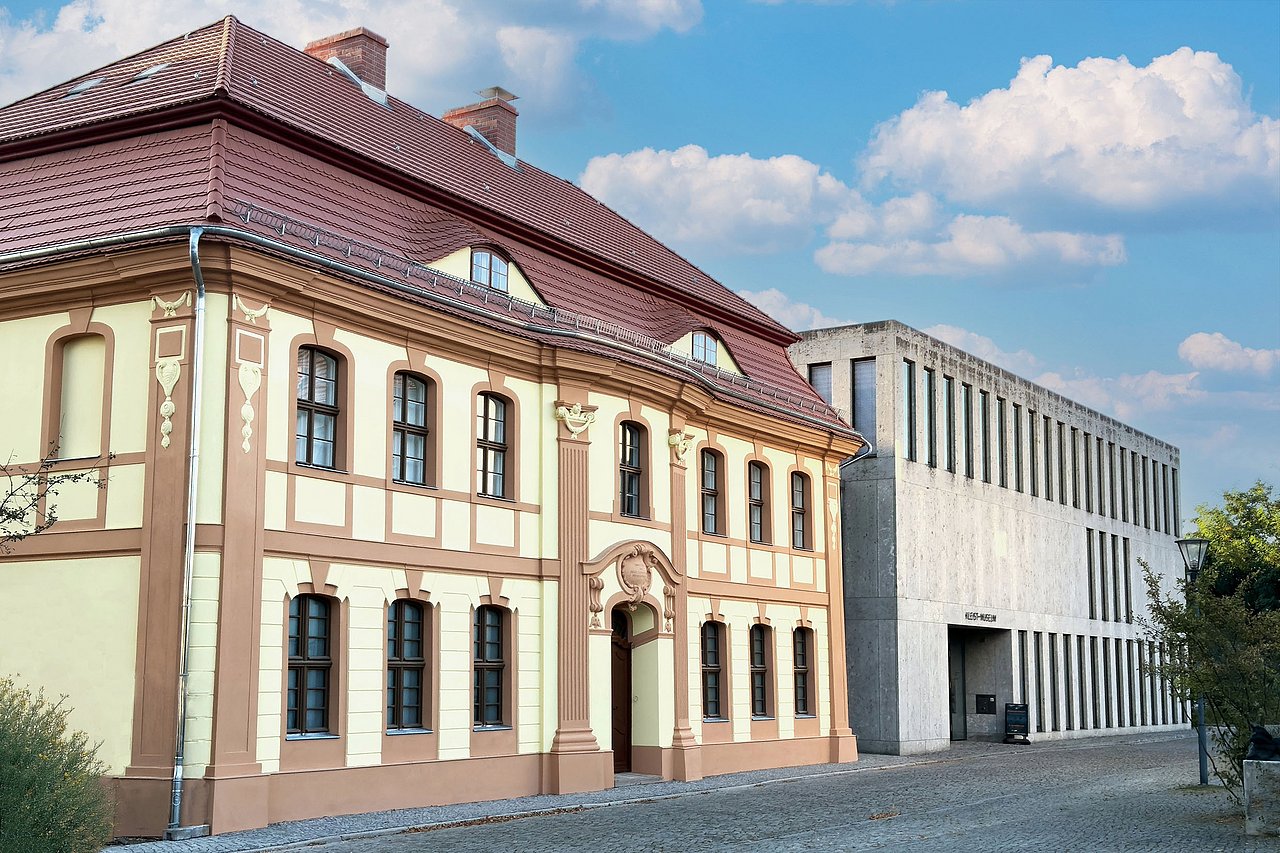
Heinrich von Kleist was born on 10 or 18 October 1777 in Frankfurt an der Oder, the eldest son of Major Joachim Friedrich von Kleist and his second wife, Juliane Ulrike von Pannwitz. He came from an old noble family in Pomerania, where a tradition of military service prevailed. His life was marked by loss from an early age: his father died in 1788, and his mother five years later.


As might be expected given his background, Kleist joined the Royal Prussian 15th Infantry Regiment in 1792 at the age of just fourteen as a lance corporal. He took part in the First Coalition War against France and rose to the rank of second lieutenant. However, a military career did not fulfil him. After seven years of service, he left the army in 1799 ‘out of a love of the sciences’ and enrolled at the Brandenburg State University in his hometown of Frankfurt an der Oder.
Whilst at university, Kleist became engaged to Wilhelmine von Zenge, the daughter of the town commander. Yet neither the engagement nor his studies were to last. As early as 1800, he abandoned both and embarked on a restless search for direction and meaning in life. His travels took him to Würzburg, Paris and Switzerland. It was there that he wrote his first play, *Die Familie Schroffenstein* (*The Schroffenstein Family*), which was published in 1803 and first performed in 1804.

The following years were marked by frequent changes of residence, professional experiments and personal crises. Kleist tried his hand at civil service for a time, worked as a trainee lawyer in Königsberg and even considered joining the French army. In 1807, he was arrested as a suspected spy in Napoleon-occupied Berlin and held as a prisoner of the French for several months.
“I want to
make a living from my dramatic works now”
Heinrich von Kleist
Following his release, Kleist decided once and for all to devote himself to literature. He lived in Dresden, Prague and Berlin, published the art magazine *Phöbus* and the daily newspaper *Berliner Abendblätter*, and in a short space of time produced a body of work of extraordinary depth and originality. His best-known plays include *The Broken Jug*, *Penthesilea*, *Käthchen von Heilbronn* and *Prince Friedrich von Homburg*. With stories such as *Michael Kohlhaas*, *Die Marquise von O....* and *Das Erdbeben in Chili*, he is now regarded as one of the most significant German-language authors of all time.
During his lifetime, however, he was largely denied great success. Many of his works were met with incomprehension or rejection. His financial insecurity and personal crises intensified. In September 1811, Kleist even submitted a request to be reinstated in the army, though this was granted only in the event of war.
On 21 November 1811, his life came to a tragic end. Together with Henriette Vogel, an acquaintance from his circle of friends in Berlin, he travelled to the Kleiner Wannsee near Berlin. There, he first shot Henriette Vogel and then himself. Both were buried immediately at the site of their deaths.
Despite his short life, Kleist left behind an exceptionally extensive body of work: eight plays, eight short stories, essays, poems, fables, epigrams and journalistic texts. His works are read, translated and performed worldwide. More than two hundred years after his death, Heinrich von Kleist is regarded as one of the most significant and, at the same time, most enigmatic authors in the history of German literature.